Industrial Ethernet solutions are the backbone of modern industrial automation, providing high-speed, reliable, and secure communication across a wide range of devices, machines, and control systems. These Industrial Ethernet solutions support the seamless convergence of IT (Information Technology) and OT (Operational Technology), enabling real-time data exchange, system integration, and improved efficiency in smart manufacturing environments. With Industrial Ethernet solutions, industries can achieve scalable, future-ready networks that drive performance and innovation.
1. Why “industrial” Ethernet is different
Office Ethernet only moves best-effort traffic at room temperature. On a packaging line or robotic cell the network must:
- Survive oil, coolants, weld spatter and 24 / 7 vibration;
- Guarantee deterministic cycle times below 1 ms for motion control;
- Be installable in drag-chains and torsion arms that bend 10 million + times;
- Keep running at −40 … +85 °C and inside IP67 housings.
The response has been a ruggedised ecosystem of cables, connectors, switches, and real-time profiles collectively branded as Industrial Ethernet solutions. These Industrial Ethernet solutions are essential for building reliable and high-performance industrial networks. Market analysts project the segment to reach US $21.9 billion by 2032, with a 9% CAGR, fueled by the rapid adoption of smart-factory initiatives and IIoT (Industrial Internet of Things) projects that rely heavily on advanced Industrial Ethernet solutions.
2. Standards & reference documents
| Layer | Key standards | What they add for industry |
| Physical cabling | TIA-1005-A cabling guidelines for “M-ICE” zones M1/E1 to M3/E3 (mechanical/EMI severity) → jacket, shield & installation rules for Cat-5e…Cat-6A copper and fibre. Cablify | |
| IEC 60079-14 wiring in explosive atmospheres; gland & armour choices for Zone 1/2 panels. | ||
| Protocols / profiles | IEC 61784 / IEC 61918 series define 27 Industrial Ethernet “Communication Profile Families” (CPF) such as PROFINET (CPF 3), EtherCAT (CPF 12) and Modbus-TCP (CPF 13) plus their installation rules. webstore.iec.ch | |
| Deterministic layer-2 | IEEE 802.1 Time-Sensitive Networking (TSN) – queuing (802.1Qbv), frame pre-emption (802.1Qbu) and clock sync (802.1AS-2020) form the basis of the forthcoming IEC/IEEE 60802 “converged TSN profile” for factories. 1.ieee802.org | |
| Application profiles | OPC UA FX, PackML, VDMA 24582 map sensor/drive data models onto Ethernet, enabling vendor interoperability. |
Class societies such as DNV incorporate the same smoke and halogen limits into their type-approval programmes (CP-0400, CP-0419).
3. Protocol options in today’s plants
| Protocol | Real-time class | Cycle/jitter* | Typical use | 2024 installed base |
| PROFINET IRT | Isochronous Real-Time via scheduled bandwidth | 250 µs / <1 µs jitter us.profinet.com | Packaging, bottling, drives | ~ 35 million nodes (PI) |
| EtherCAT | Hardware-based “processing-on-the-fly” | 12.5 µs / 1 µs | Robots, vision, servo axes | +11 million nodes in 2024 alone EtherCAT |
| EtherNet/IP (CIP Sync) | CIP Motion uses IEEE 1588 PTP | 250 µs / 1 µs | Conveyors, AGVs | ~ 40 million nodes |
| TSN (draft 60802) | Scheduled traffic, FRER redundancy | <50 µs / <1 µs | Next-gen multi-vendor converged network | Field trials 2023-25 |
*Typical vendor figures; actual limits depend on network size and device class.
4. Rugged media & connectors
| Element | Industrial flavour | Why it matters |
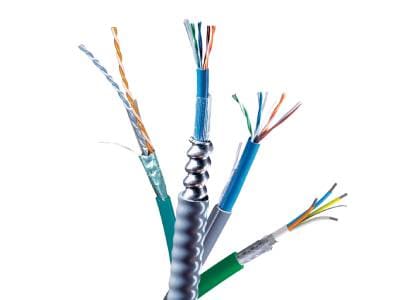
| Cable | High-flex Cat-6A PUR/PVC-FR: 26 AWG stranded, double-shielded SF/UTP, drag-chain rated to 10 million bends and torsion ±180 ° / m. AmazonShow Me Cables | Withstands robot arm twisting and coolants without impedance drift. |
| Connectors | M12 X-coded (IP67) or ix Industrial: threaded, vibration-proof, up to 10 Gb/s in −40 … +85 °C; RJ45 retained for panels. L-comShow Me Cables | Prevents accidental pull-outs and seals against dust & wash-down. |
| Fiber | LC-Industrial or M12-OFO; cables with 900 µm tight-buffer and stainless armour for EMI-heavy welding cells. | Immune to ground-loops and lightning on KM-scale sites. |
| Single-Pair Ethernet (SPE) | IEC 63171-6 IP67 connectors, 10 Mb/s up to 1 km + PoDL power. | Replaces 4-20 mA loops with Ethernet right to sensors. |
5. Switch technology
- TSN-aware edge switches schedule traffic windows so time-critical motion frames never collide with HMI video streams.
- Layer-2 ring redundancy (MRP, DLR, PRP/HSR) restores link faults in <50 ms or provides zero-switchover hit for safety PLCs.
- Managed QoS queues tag safety traffic with VLAN PCP 6-7; generic IT traffic sits at PCP 0-1.
- PoE++ ports (IEEE 802.3bt) now deliver 90 W to cameras and LiDARs, reducing auxiliary power wiring.
Many vendors offer IP67-rated “machine-mount” switches with M12 ports so builders drop a single backbone trunk into the cabinet and fan out short patch leads on the robot or conveyor side-panels.
6. Designing the cabling infrastructure
- Zone classification – map each run to TIA-1005-A M-ICE zones. M3/E3 areas (presses, weld cells) demand double shield, PUR jacket and M12 or ix connectors; M1/E1 office drops can stay PVC + RJ45. Cablify
- Motion profile – if the cable enters a drag-chain keep bend radius ≥ 7.5 × OD and pick a drag-chain warranty (e.g., 36 months / 10 million cycles).
- EMC & grounding – use braided + foil shields (SF/UTP) and 360 ° shield-clamp glands; bond both ends when allowed by drive vendor.
- Future bandwidth – Cat-6A supports 10 Gb/s up to 100 m; that headroom lets you add HD vision or edge AI later without repulling.
- PoE budgeting – sum device power and allocate at least 20 % spare across redundant supplies; watch voltage-drop on long SPE runs.
- Certification – insist on UL / CSA (NFPA 79) or CE, and drag-chain/test reports per DIN EN 50396 or vendor-equivalent.
7. Emerging trends (2025 – 2028)
- Converged TSN profile IEC/IEEE 60802 nearing final ballot; pilots prove deterministic OT traffic can coexist with IT flows on the same VLAN fabric. 1.ieee802.org
- SPE + APL (Advanced Physical Layer) brings intrinsically safe 10 Mb/s Ethernet into Zone 0/1 instrumentation, replacing fieldbus spurs.
- Hybrid power-data “one-cable” robotics—24 VDC + Cat-6A pairs under one PUR jacket—trim dress-pack weight by 30 %.
- Machine-learning diagnostics inside switches watch jitter histograms and pre-alert maintenance when cabling or connector impedance drifts.
- Eco-designed cables with recycled PUR and halogen-free fillers that still meet UL Oil Res II and FT-1 flame tests hit catalogues this year.
Conclusion
Industrial Ethernet is no longer just “RJ45 in a conduit.” It is a layered solution that starts with rugged Cat-rated, high-flex cables and IP67 connectors, scales through real-time protocols like EtherCAT, PROFINET IRT and soon TSN, and ends in managed, redundant switches sized for PoE cameras, safety PLCs and cloud gateways. Following TIA-1005-A zoning, IEC 61784 profiles and vendor bend-cycle guarantees lets machine builders roll out networks that meet OEE targets today and still have bandwidth for the AI-enabled, data-driven factories of tomorrow.